
A VCC may accommodate multiple sub-funds and SPVs under one overarching corporate structure.
Each sub-fund may pursue a distinct investment strategy, enabling fund promoters to manage different portfolios, investment objectives and investor groups within the same VCC.
One of the principal advantages of a VCC is the statutory segregation of assets and liabilities between its sub-funds and SPVs.
The liabilities attributable to one sub-entity are generally restricted to its own assets, providing protection against liabilities arising in other sub-entities, subject to applicable law.
A VCC may accommodate both Collective Investment Schemes (CIS) and Closed-End Funds (CEF) within the same umbrella structure, subject to FSC approval.
This flexibility allows fund promoters to establish different investment strategies without necessarily creating a separate overarching company for each fund.
A sub-fund or SPV may elect to have legal personality distinct from that of the VCC, subject to the relevant incorporation and regulatory requirements.
This offers additional flexibility in structuring ownership, contractual relationships and investment activities.
A VCC provides flexibility in issuing, redeeming and repurchasing shares, subject to applicable legal requirements and the nature of the relevant fund.
This is particularly useful for investment strategies requiring periodic subscriptions and redemptions.
Multiple sub-funds may benefit from shared corporate infrastructure, governance arrangements and professional service providers, where permitted.
This can generate economies of scale and reduce duplication of administrative functions.
Subject to applicable restrictions and regulatory requirements, sub-funds and SPVs within the same VCC may invest in other sub-entities of that VCC.
This can facilitate master-feeder arrangements and other investment structures.
A VCC may establish SPVs to undertake permitted ancillary activities, including investment holding arrangements and certain family office activities.
An SPV cannot independently operate as an investment fund.

Accommodates multiple investment strategies, asset classes and investor groups within an integrated structure.
Provides statutory separation between sub-entities, reducing the risk of liabilities affecting unrelated portfolios.
Shared governance and administrative infrastructure may reduce operating costs compared with maintaining multiple standalone investment companies.
Allows fund promoters to establish additional sub-funds or SPVs as their investment activities expand, subject to the required approvals.
Offers access to Mauritius's established financial services ecosystem and professional fund administration infrastructure.
Operates under a dedicated legislative framework and the supervision of the Financial Services Commission.
Can accommodate open-ended and closed-end funds under one structure, subject to the relevant approvals.
A qualifying VCC holding a Global Business Licence may access applicable tax treaty benefits and tax reliefs, subject to tax residence, economic substance and other eligibility requirements.
The establishment and operation of a Mauritius VCC are governed principally by the Variable Capital Companies Act 2022, the Companies Act 2001, the Financial Services Act 2007 and, where applicable, the Securities Act 2005.
A VCC may be newly incorporated in Mauritius. An existing eligible Mauritius company may also be converted into a VCC, while qualifying foreign companies may be able to redomicile to Mauritius.
A VCC must obtain the appropriate authorisation from the Financial Services Commission before undertaking regulated activities.
Each proposed sub-fund requires the relevant FSC approval and must comply with the applicable fund regulatory framework.
Where the VCC satisfies the relevant statutory criteria for Global Business, a Global Business Licence is required.
Appropriate directors, corporate governance arrangements, internal controls and management procedures must be maintained.
Depending on the activities and fund category, the VCC may require appropriately licensed or authorised fund managers, administrators, custodians, auditors and other professional service providers.
The VCC and its relevant sub-entities must comply with applicable AML/CFT, beneficial ownership, financial reporting, statutory filing and ongoing regulatory obligations.
A Mauritius VCC may be particularly suitable for:
Seeking to establish multiple investment strategies within one umbrella structure.
Managing separate investment portfolios, investment rounds or sector-specific strategies.
Seeking appropriately governed and regulated investment structures.
Managing investments across different projects, sectors or geographic markets.
Seeking a scalable investment fund platform with multiple sub-funds.
Seeking suitable structures for segregated investment portfolios or permitted family office activities.
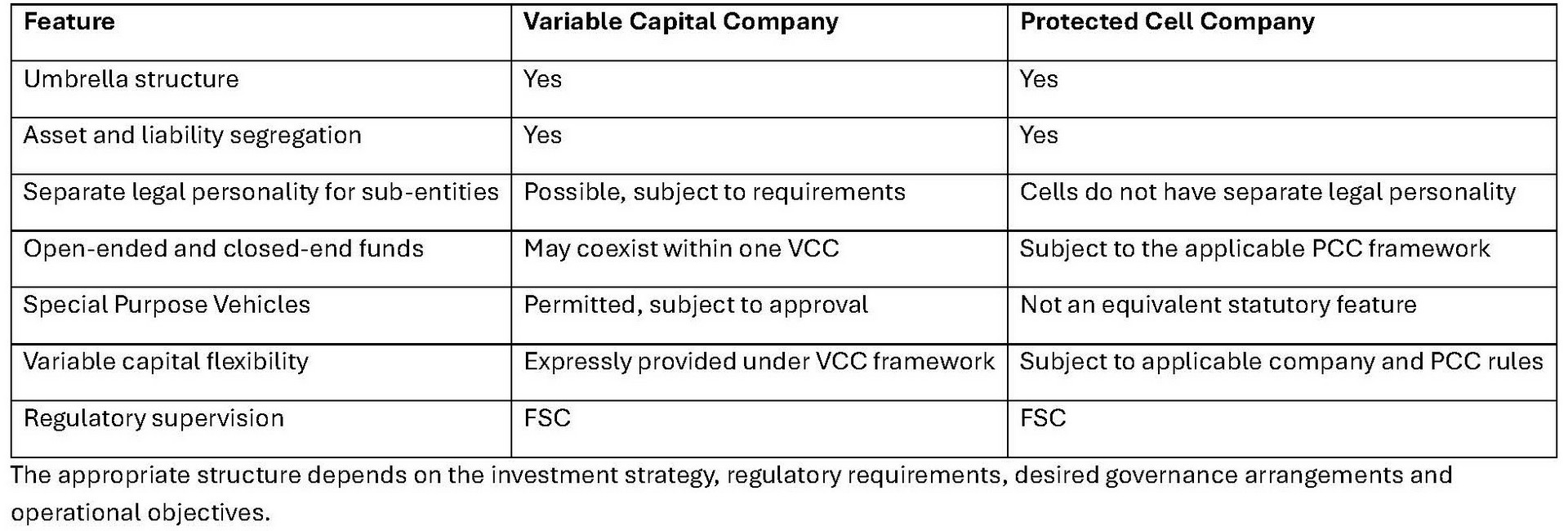
Although both structures provide statutory segregation of assets and liabilities, they differ in their legal and operational flexibility.